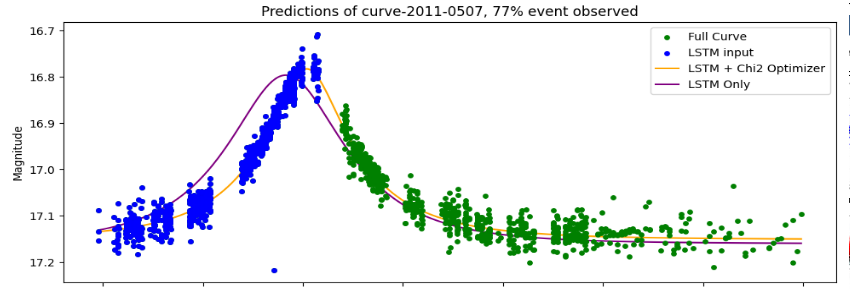
Don’t worry, that star is fine. It’s a microlensing event, and I’ve trained a model on 4,312 of them to predict their shapes before they end. Essentially, a massive object drifted in front of the star and bent its light around itself, so the star brightens from our perspective.
I chose this problem because I could observe it right at my home with my telescope, day by day. Most of my work starts like this, from a Wikipedia rabbit hole to a full-on research project.

OGLE has recorded more than 20,000 microlensing events in the photograph above. All of them are too faint to see in this wide view, so I used Antares, the brightest star in it, as a replacement.
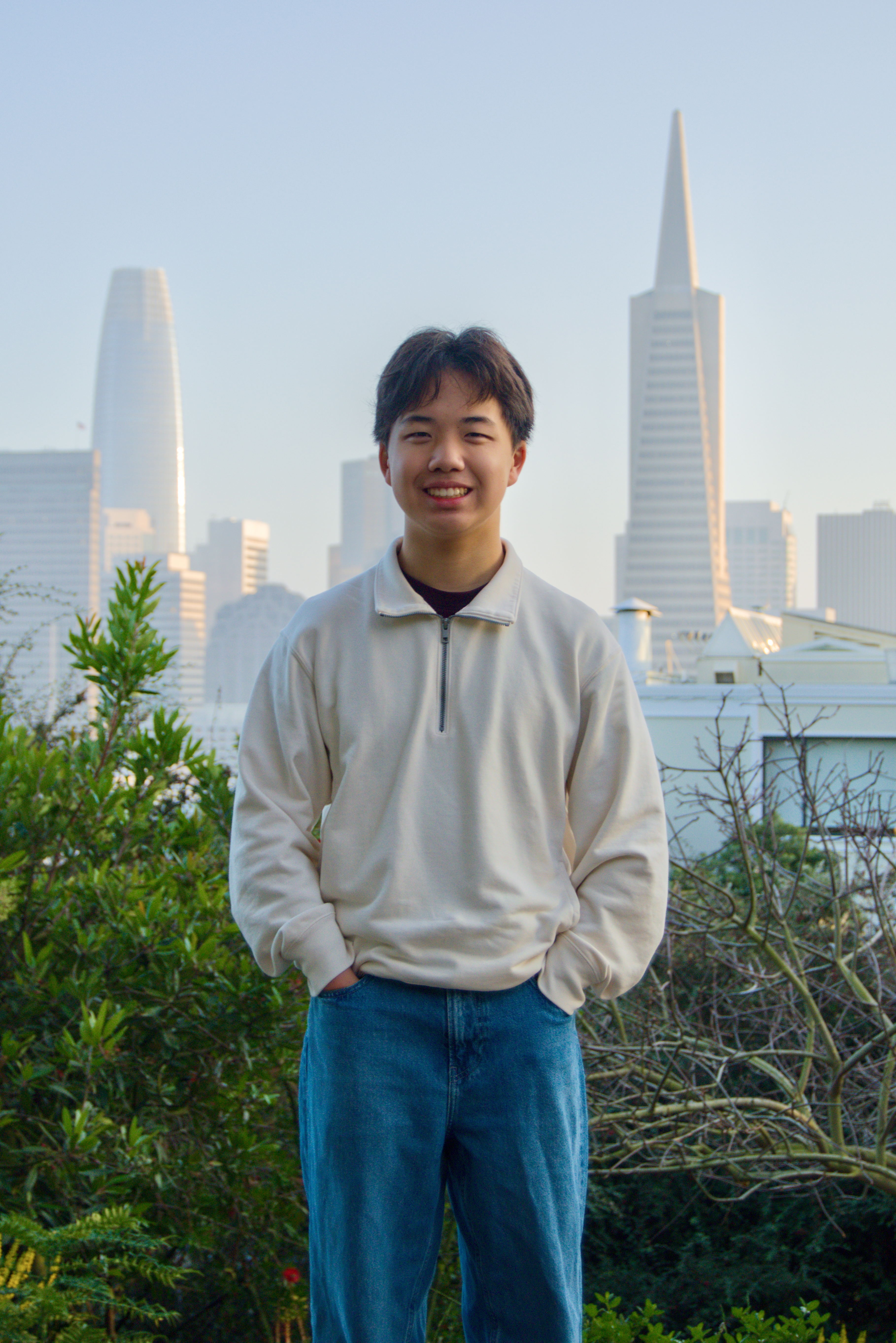
Hi, I’m Joseph! I’m a second-year at Berkeley studying applied math and CS, originally from Minneapolis, MN. I also compete in Rubik’s cube speedsolving, mostly the Square-1 puzzle variant, and shoot deep-sky astrophotography.
My interests lie in machine learning theory, specifically, how models represent and recover information. I’m working on gravitational-wave parameter estimation with Michael Coughlin at the University of Minnesota, and on language model interpretability with Nathan Hu at Stanford.
I’ve been speedcubing for 8 years now, and have a 6.78s official Square-1 average which ranked me 34th in the world. I also teach a class at Berkeley about solving the Rubik’s cube. You’ll see me with my camera when I’m out sightseeing or at night with the Milky Way.
Selected Works in Machine Learning, Astrophysics, and Computer Vision: A Survey of Recent Contributions
1UC Berkeley, 2University of Minnesota
Correspondence: joseph_ong@berkeley.edu, josephong.dev
Abstract
I present four contributions spanning gravitational wave astronomy, microlensing event prediction, language model interpretability, and computer vision. First, I describe LIGHT, an LSTM light curve predictor trained on 4,312 OGLE events and paired with a χ² optimizer, achieving R² = 0.81 across the five Paczyński parameters, with a forthcoming publication in Research Notes of the AAS. Second, I outline ongoing work extending the AMPLFI normalizing flow pipeline with CNN encoders that read Q-transform spectrograms rather than raw detector strain. Third, I present a text-dreaming method built on LARGO that recovers what an MLP neuron in Llama 3.1 8B responds to, reaching roughly 1.10x the strongest activation found in the dataset. Fourth, I introduce Cubuddy, a computer vision and LLM system for real-time Rubik’s cube coaching. Code and data available at github.com/joseph-ongg.
LIGHT: Light-Curve Inference for Gravitational-Lensing Hypothesis Testing
Microlensing occurs when a massive body passes in front of a background star and its gravity magnifies that star’s light, producing a characteristic brightening and fading [1]. Five quantities, the Paczyński parameters, describe the event, and recovering them before it has finished is difficult, as the peak is frequently absent from the data at the time of inference. I train an LSTM, a network that reads a sequence in order, on 4,312 OGLE light curves [2], each truncated within the first half of its baseline, to estimate those five quantities. That estimate then initializes a χ² optimizer, which adjusts the fit until it both matches the observations and satisfies the lensing equation. The combination attains R² = 0.81; neither stage reaches this alone. Forthcoming in Research Notes of the AAS.
AMPLFI: CNN Encoders for Gravitational-Wave Parameter Estimation
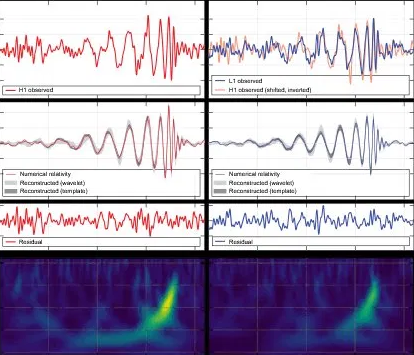
When two black holes merge, the gravitational wave they emit carries the masses, spins and distance of the pair. Recovering those quantities by conventional sampling takes hours, whereas the telescopes following up an event must be pointed within minutes. AMPLFI avoids the sampler: a normalizing flow, a network trained to output a distribution rather than a single answer, maps detector data directly to a distribution over the source parameters [3]. I modify its front end, replacing the encoder that reads the raw detector signal with CNN encoders that read Q-transform spectrograms, images of frequency against time on which the merger traces a clean rising arc and separates from detector noise. The improvement is concentrated at weak signals, the regime in which the parameters are least certain and conventional sampling is slowest. Training the encoder jointly with the flow is unstable across a parameter space spanning several orders of magnitude in both mass and distance.
Text-Dreaming with LARGO: Recovering What a Language Model Neuron Responds To
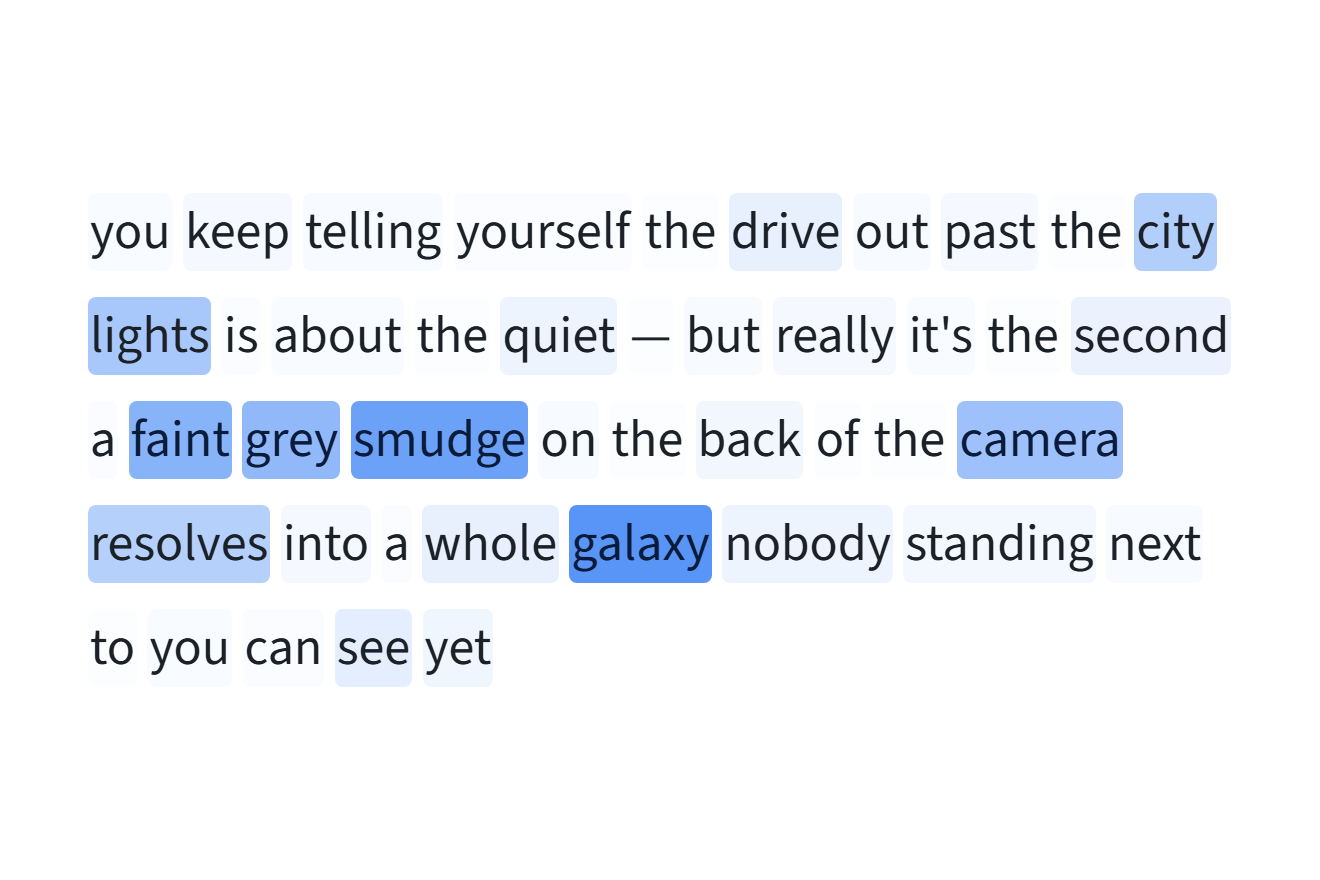
A neuron inside a language model is usually described by searching a large body of text for the passage that excites it most, which confines the description to whatever that text happened to contain. One neuron labelled this way appeared to respond to the word “extra” in medical writing; its strongest response was to mentions of the Pope. I present a method that searches for such an input rather than retrieving it, optimizing a prompt directly in the model’s embedding space and then asking the model to put that embedding back into words, repeating the cycle so the result stays close to real text rather than drifting into vectors no sentence can express. Applied to MLP neurons in Llama 3.1 8B, it reaches roughly 1.10x the strongest activation present in the dataset, from an optimizer that saw 25,600 pieces of text in total.
Cubuddy: Real-Time Rubik’s Cube Coaching via Computer Vision and LLM
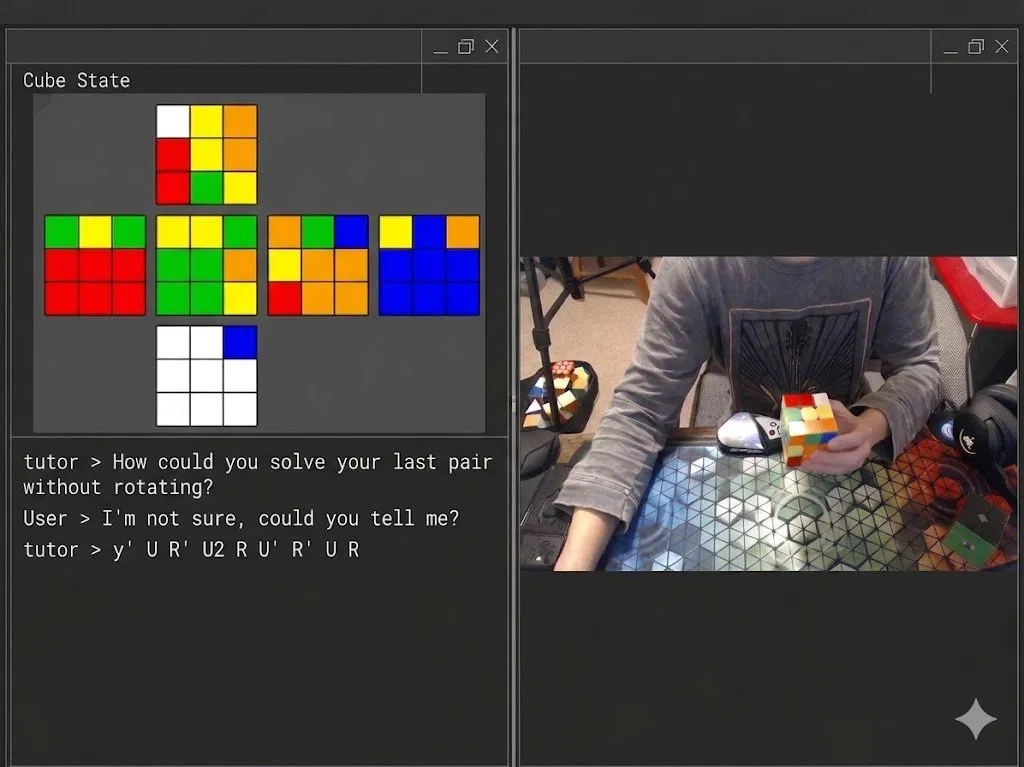
Conventional tutorials present an algorithm without the conditions under which it applies, leaving the learner to work out when to use it. I describe Cubuddy, which reconstructs the full state of a cube from a single webcam frame and compares the user’s solution against one produced by a search-based solver [4], set to a chosen difficulty. The difference between the two move sequences is passed to an LLM, which returns either a critique or a hint that withholds the answer. Fixed color thresholds proved insufficient under the motion blur induced by fast turning, so the sticker reader was replaced with a CNN. Recovering which moves the user made from unconstrained video remains the limiting component.
Conclusion
The four systems share a common setting: drawing conclusions from observations that are incomplete, noisy, or available only once. In both astrophysical cases an approximate answer is accepted in exchange for speed, since the opportunity to observe closes before an exact one can be computed. Work on AMPLFI, LARGO and Cubuddy is ongoing; further results are in preparation.
References
[1] Paczyński, B. (1986). Gravitational microlensing by the galactic halo. ApJ, 304, 1–5.
[2] Udalski, A. et al. (1992). The optical gravitational lensing experiment. Acta Astronomica, 42, 253–284.
[3] Dax, M. et al. (2021). Real-time gravitational wave science with neural posterior estimation. PRL, 127, 241103.
[4] Korf, R. E. (1997). Finding optimal solutions to Rubik’s cube using pattern databases. AAAI, 700–705.
all research + projects